Showing posts with label planetary rings. Show all posts

Tuesday, October 8, 2024

Did Earth Once Possess a Ring Like Saturn?

 When I show people astronomical sights through my telescope, the one view that elicits the most comments is Saturn with its rings. Many times I’ve heard people say “Wow! That’s amazing.” Or, “Oh, that’s not real. You have a picture in there.” Saturn, more than any other common backyard telescope target, looks like the pictures you’ve seen in books.
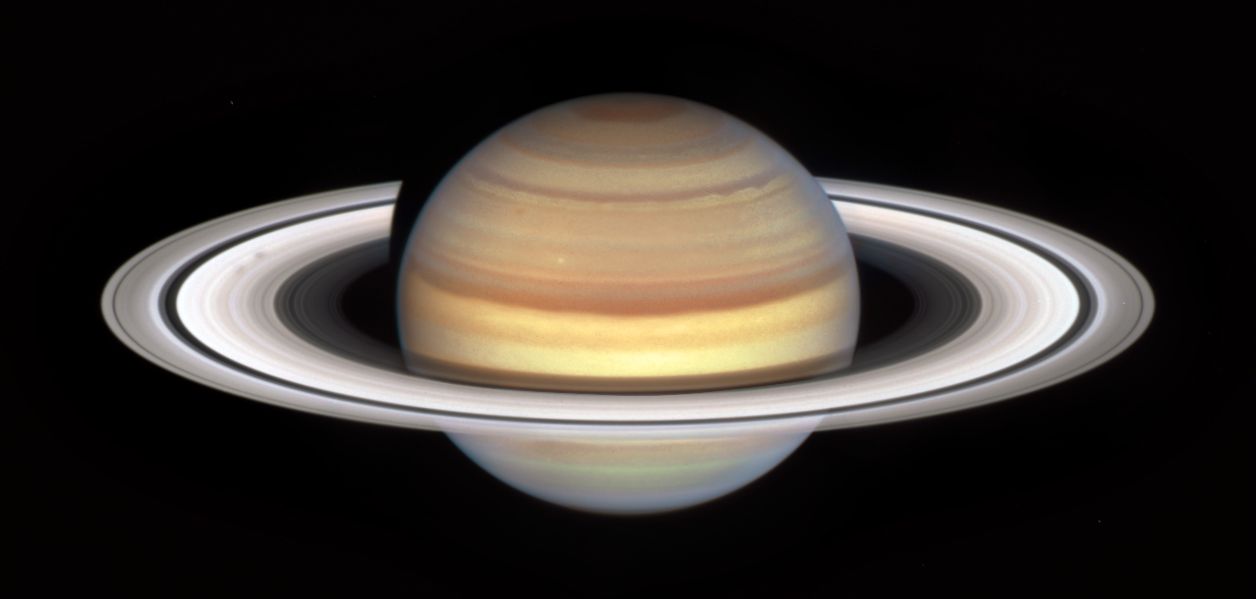
Saturn.


Saturn isn’t the only planet with a ring system. Jupiter, Uranus, and Neptune also have rings but are only visible with very powerful telescopes or spacecraft passing nearby.

Imagine the sense of awe if we lived on a planet with rings, something we sometimes see in science fiction movies. Had you been around on Earth 466 million years ago, you might have been able to enjoy that very experience. A recent study suggests that Earth may very well have sported a ring like Saturn.

Artist's conception of Earth with rings.

Planetary rings are ephemeral. They don’t last forever, although they do exist for millions of years. The evidence for Earth’s possible ring is circumstantial but quite intriguing. Starting about 466 million years ago, Earth experienced a period of enhanced meteor cratering, a period known as the Ordovician impact spike. During that cratering period, virtually all of the impacts on Earth, centered on a narrow band along the equator. Typically, impacts should occur randomly over the Earth’s surface.

This narrow cratering band implies that the objects striking Earth all came from that area of the sky over the equator. The easiest explanation for such a narrow band of cratering events along the equator is a ring of debris encircling our planet. If a ring forms around a planet, it will always settle over the equator.

During the same time frame, sedimentary rocks show a large increase in L chondrite material. L chondrite-type asteroids are common in the asteroid belt. Denizens in the asteroid belt occasionally collide, scattering debris around the solar system. 

Artist's conception of two asteroids colliding. 


The researchers, led by Andrew G. Tomkins, a geologist at Monash University in Australia, suggest that one large fragment came close to Earth, passing so closely that Earth’s gravity shattered it and the debris formed a ring.

Based on the cratering record, the study participants claimed the ring lasted approximately 40 million years, a typical lifetime for a planetary ring. During that same period of time, Earth experienced one of its most intense glaciation events and mass extinctions known as the Hirnantian global icehouse period. The researchers suggest that shading from the ring decreased solar radiation reaching the planet’s surface, triggering the short but intense glaciation period. “The existence of such a ring, forming around 466 million years ago and persisting for a few tens of millions of years could explain several puzzles in our planet’s past,” Tomkins wrote.

None of this evidence is absolute proof that we once had a ring like Saturn’s, but it is strongly suggestive. More work needs to be done to help corroborate their conclusion.


Each month, I write an astronomy-related column piece for the Oklahoman newspaper. After publishing it there, I post that column on my blog page.

 This is reprinted with permission from the Oklahoman and www.Oklahoman.com.

Thursday, May 4, 2023

Is Mars About to Have Saturn-like Ring?

 When Earth formed some four and a half billion years ago, it initially had no moon, just as both Venus and Mercury are moonless. Not long after its formation, Earth was struck by a Mars-sized object. That collision knocked material off our young planet that quickly coalesced into the Moon. The collision caused Earth to spin quite rapidly, so fast that a day took only about 4 hours. The Moon was also much closer to Earth, less than a tenth of its current distance.

The Moon’s gravity created a large tidal force on Earth, slowing its spin a bit each year until our day is now 24 hours long. As Earth’s day lengthened, the Moon moved farther away. Good for the Moon. Had it remained that close, Earth’s gravitational tug on the Moon would pull it toward our planet. At some point before it collided with Earth, the tidal force on the Moon would have ripped it apart creating a ring of debris surrounding our planet.

Mars possesses two tiny moons. Phobos is only 14 miles across. Deimos is even smaller, a mere 8 miles. Both are likely captured asteroids.

Phobos orbits Mars from a distance of only 3,700 miles, less than half the diameter of Earth. It is the closest known moon to its planet. It’s so close, Mars’ gravity is slowly pulling it even closer. When it gets too close to Mars, the gravity of the Red Planet will rip it apart.

Phobos is already shown signs of this stress. Close-up photos by NASA probes show parallel grooves running across the entire moon. When the Mars Reconnaissance Rover first photographed Phobos and astronomers saw the grooves, they initially thought they were caused by the impact of the large meteor that created Stickney Crater. The collision was so powerful, it nearly shattered the small moon.

                         Stickney Crater and grooves on Phobos. Credit NASA and JPL.

Astronomers now realize that these grooves are caused by the gravity from Mars creating a strain on Phobos so strong it is having trouble holding itself together. Before long, in astronomical terms, perhaps a few million years, Phobos will shatter, forming a ring around Mars.


*


NASA’s Artemis program plans to send astronauts to the Moon by the middle of this decade. But that’s not the end purpose of the Artemis program. Its ultimate goal is to land humans on Mars. To that end, NASA has constructed a simulated Mars Habitat at the Johnson Space Center in Houston. Later this year, four people will enter the simulator and be locked in for a year. This is the first of three crews to stay in the Mars habitat. These will simulate life on Mars, giving NASA valuable data for when crews leave for the Red Planet.


                                                   Mars Habitate Simulator. Credit NASA


Each month, I write an astronomy-related column piece for the Oklahoman newspaper. After it is published there, I post that same column to my blog page.


This is reprinted by permission from the Oklahoman and www.Oklahoman.com.